Maybe it's time to make thinking hard again?
Have you ever blindly hit “Agree to terms and conditions” just to quickly try a trendy photo app filter?
Have you ever followed Google Maps into an unfamiliar place, only to panic when your battery is about to die because you know you’ll struggle to find your way back?
Or forgotten an ongoing conversation until that little red notification dot appears, reply on reflex, then immediately jump out to do something else?
Everything is laid out for us. At 12:59, a notification pops up: “Meeting at 13:00”.
You tap “Join”, wait for the camera to turn on, and repeat that ritual every day.
When the meeting ends, Grab sends you a coupon, you open it right away…
You don’t even have to think about what to eat because an entire curated list of dishes is already on your screen. Just choose.
We’ve become so used to everything being prepared on a black screen, where a single tap lights up a bundle of choices.
But what is the price we pay for that?
We do things without remembering why we do them, why we receive them, or how we came to know them.
Since when did kids learn that if they open that red icon, they’ll see baby shark doo doo doo doo?
Who trained humans to instinctively take photos of anything beautiful or strange and for some, immediately post it on social media?
Meeting notes are now summarized by AI; all we have to do is read them and jump straight into “next steps”.
Everything is so convenient and always ready for us to pick up and keep walking.
At this point, someone will say: “But calculators didn’t kill mathematicians, right?”
That’s true, but they did change how we approach solving problems.
We outsource what calculators can do so we can supposedly focus on “higher-level” things.
But can we really reach those higher places if the foundations are shaky, unstable, because we never fully understood them to begin with?
As a UX Designer, my north star is to design the “smoothest” possible flows so users can complete tasks as fast as possible.
I live with that mindset every day, in every internal check-in and every client meeting.
But sometimes, I feel over-saturated.
Apps seem to be slowly lulling users into a comfortable, automated stream that serves business goals while quietly stealing their time and their ability to think.
I get scared of how I “steer” people:
- Presenting a discount in a certain way so they buy faster
- Nudging their fear of missing out so they care about vaccines or health
- Designing something that looks “trustworthy” enough so investors feel safe to wire money
Everything still looks “ethical” on paper, but inside, I can’t help wondering:
How much of users’ thinking are we quietly turning off for them?
AI: yeah of course we can’t skip AI in this conversation
It’s the invisible assistant that’s always there - even when we didn’t explicitly call for it.
We ask AI to “keep it short”, “get to the point”, “give me clear action items”.
We get the answer without needing the context.
We get a full bullet list for our presentation and paste it straight into slides, without pausing for even a second to ask:
“Why am I choosing this content? Do I actually believe it?”
We’re outsourcing the most human capabilities to machines, and slowly becoming strangers to our own thinking process.
We trade long-term memory for instant convenience.
Knowledge that should have taken root deep inside our minds becomes a set of “temporary files” useful only until the current task is done, then discarded.
We say we’re lost, but not lost enough to really stop and look at where we are
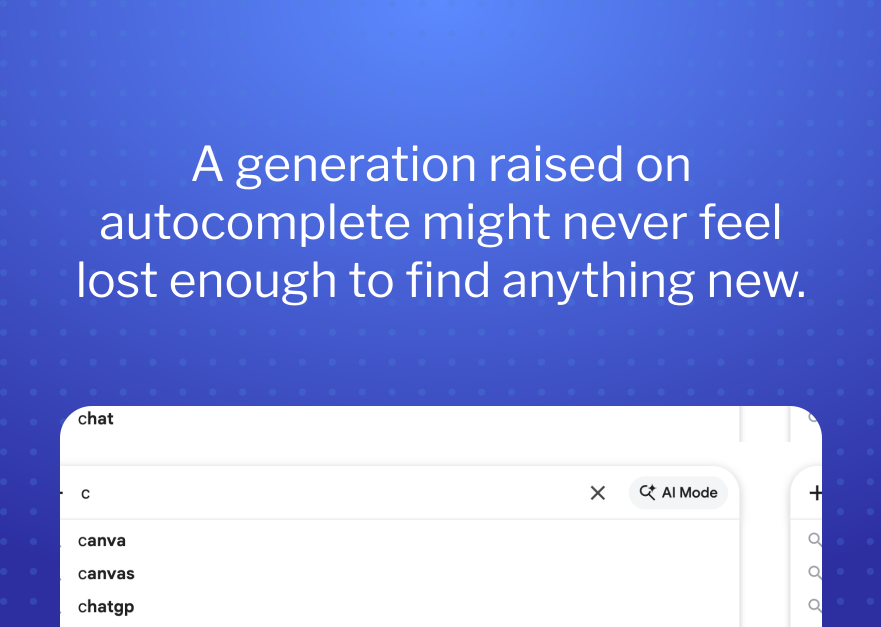
In this video, the author says:
“A generation raised on autocomplete might never feel lost enough to find anything new.”
It’s such a beautiful sentence.
And yet, ironically, people today say they feel more lost than ever.
Healing workshops, “find yourself” podcasts, self-help books…they’re everywhere.
Maybe it’s because our comfort zone is too big now.
- Hungry? Open GrabFood.
- Don’t know what to eat? The homepage already has a curated list ready for you.
- Craving something sweet? There’s always bubble tea at the top of the list.
- Going out tonight and don’t know which place is good? Just look at Google Maps ratings.
- Don’t know the way? Google Maps again.
- Out of detergent? Open a shopping app and it’ll suggest the “best sellers” first.
You see the pattern.
We no longer have to struggle for basic life experiences, so “happiness” shaped by media and modern aspirations also becomes something grand:
“a high-income lifestyle”, “a dream apartment”, “a job with a fancy title”.
Where you are now is framed as temporary not enough, not yet it.
No wonder peace feels so far away.
Thinking harder, to feel more
I’m writing this because a big part of me wants to reclaim everyday joy.
After years working in tech, I got burned out by things that feel too purely technical.
Eight hours a day, my conversations with clients and colleagues orbit tech, platforms, features, roadmaps, “how to scale this”, “how to automate that”.
This essay is both a personal reflection and a small experiment:
If we deliberately make some parts of life “hard” again:
If we put real effort back into our thoughts and choices, will our ability to feel joy in small, ordinary things come back?
I don’t have a neat conclusion.
But maybe the first step is this:
Next time you reach for your phone to let it think for you, try pausing for three seconds and ask:
“If I didn’t have this shortcut, what would I actually do?”
If that question feels uncomfortable, that might be a good sign.